NAG-003147 · Accepted whole
The full tame inertia criterion for a supplied model
I Descent of the polarized mixed tower
Open in the English reader · PDF page 2073
Statement · exact TeX
\begin{theorem}[The full tame inertia criterion for a supplied model]
\label{cand:f5gen:modeldescent}
Let \(L/K\) be finite Galois satisfying \hyperref[eq:f5gt:pdf-derived:tame-hypotheses]{(Tg)}, put \(O=K^\circ\), \(B=L^\circ\),
and let \(G,I,l\) be as in \hypertarget{foundations.nag003147.use.nag003145.field-and-residue-notation}{}\hyperref[f5gt:pdf-derived:inertiafiltration]{Theorem~1.55.3}. Let \(Y_B/B\) be a supplied
projective, flat, finitely presented nodal scheme of relative dimension
one with a semilinear \(G\)-action. There is a projective, flat, finitely
presented nodal \(O\)-scheme \(Y\) of relative dimension one and a
\(G\)-equivariant comparison
% @formula 22 231
\hypertarget{foundations.nag003147.formula.22}{}
\begin{equation}\tag{22}
 Y\times_O B\simeq Y_B
\end{equation}
if and only if \(I\) acts identically on the entire scheme \((Y_B)_l\).
Such a descent is unique up to the unique isomorphism compatible with \hyperlink{foundations.nag003147.formula.22}{(22)}.

A supplied \(G\)-linearized relatively ample invertible sheaf \(\mathcal L_B\)
descends, with its specified linearization and comparison, if and only if
its entire special-fibre \(I\)-action is the identity. Its descent is relatively
ample and unique with that comparison. There is no identity requirement on
the residue Galois quotient \(G/I\) and no further tensor power of
\(\mathcal L_B\) is needed.
\end{theorem}
Full selected proof · exact TeX
\begin{proof}
\hypertarget{foundations.nag003147.scheme-component}{}Assume the whole-special-scheme identity. Take \hypertarget{foundations.nag003147.use.nag003145.normal-series}{}\hyperref[eq:f5gt:pdf-derived:normal-series]{(19)} and descend from
\(F_{j-1}^\circ\) to \(F_j^\circ\) successively using \hypertarget{foundations.nag003147.use.nag003146.scheme-and-residual-transport}{}\hyperref[cand:f5gen:normalizerdescent]{Lemma~1.55.4}, with
\(P=G/J_{j-1}\) and \(Q=J_j/J_{j-1}\). Normality in \(G\) makes these
groups and their actions on the corresponding fields well defined. At each
step projectivity, flatness, finite presentation and nodal relative dimension
one are retained. Every coefficient residue field is \(l\). Reducing the
actual equivariant comparison therefore identifies the new special scheme,
with its remaining inertia action, with the previous one. The remaining
inertia is still the identity. This argument uses the constructed comparison;
it does not assume that invariants commute with reduction.

If \(r\ge1\), it suffices to perform the first \(r-1\) steps. The last
field configuration \(K\subset M\subset F_{r-1}\) then satisfies exactly
\hyperref[fnd:mixedtamevaluationringcontext]{(T)} of \hypertarget{foundations.nag003147.use.nag003009.mixed-scheme-comparison}{}\hyperref[cand:f5mix:transitivity]{\texttt{NAG-003009}}: \(M/K\) is its actual unramified
Galois lift, \(F_{r-1}/K\) is Galois, and \(F_{r-1}/M\) is one exact Kummer
step. That frozen theorem performs the final Kummer and unramified descents.
Composing the comparisons proves \hyperlink{foundations.nag003147.formula.22}{(22)}.

For completeness, when \(I=1\) the field \(L=M\) itself is the actual
unramified lift. The torsor identity in \hypertarget{foundations.nag003147.use.nag002262.unramified-coefficient-torsor}{}\hyperref[v036:f5:unramifiedcoefficients]{\texttt{NAG-002262}}
turns the full \(G\)-action into an fpqc descent datum. It is effective
for this projective scheme by \hypertarget{foundations.nag003147.stacks.0CCJ.projective-scheme-effectivity}{}\stacks{0CCJ}. Properness and finite
presentation descend by \hypertarget{foundations.nag003147.stacks.02L1.properness}{}\stacks{02L1} and \hypertarget{foundations.nag003147.stacks.02L0.finite-presentation}{}\stacks{02L0}, and flatness
and nodal relative dimension one by \hypertarget{foundations.nag003147.stacks.0C5E.flat-nodal-relative-dimension-one}{}\stacks{0C5E}. The finite locally
free surjective pullback has an ample invertible sheaf; \hypertarget{foundations.nag003147.stacks.0BD4.finite-locally-free-ample-transfer}{}\stacks{0BD4}
gives one downstairs. Properness over the affine base then gives projectivity
by \hypertarget{foundations.nag003147.stacks.0B45.proper-with-ample-over-affine}{}\stacks{0B45}.

\hypertarget{foundations.nag003147.same-bundle-component}{}If \(\mathcal L_B\) has full residual \(I\)-identity, apply the bundle part of
\hypertarget{foundations.nag003147.use.nag003146.same-bundle-and-residual-transport}{}\hyperref[cand:f5gen:normalizerdescent]{Lemma~1.55.4} at these same steps. The new residual module is identified
with the old one by the actual bundle comparison, so the required identity
persists. For \(r\ge1\) the bundle clause of \hypertarget{foundations.nag003147.use.nag003009.mixed-same-bundle-comparison}{}\hyperref[cand:f5mix:transitivity]{\texttt{NAG-003009}}
finishes the descent of this very bundle. In the unramified case \(I=1\),
fpqc sheaf descent \hypertarget{foundations.nag003147.stacks.023T.same-bundle-effectivity}{}\stacks{023T} is effective; finite local freeness descends
by \hypertarget{foundations.nag003147.stacks.05B2.finite-locally-free-sheaf}{}\stacks{05B2}, and its rank is one by surjective base change. Relative
ampleness descends by \hypertarget{foundations.nag003147.stacks.0D2P.relative-ampleness}{}\stacks{0D2P}.

Conversely, \hyperlink{foundations.nag003147.formula.22}{(22)} identifies the special scheme with \(Y_k\times_k l\).
Inertia fixes \(l\) and acts only on coefficients, so acts identically
on that whole scheme. The same calculation on a pulled-back line bundle
gives identity on its full residue module. Uniqueness follows at each
ramified step
% @witness proof_continued 232:4-7
from the canonical invariant descent and its functoriality. At the unramified
step it is full faithfulness in \hypertarget{foundations.nag003147.stacks.02W0.underlying-scheme-uniqueness}{}\stacks{02W0} and \hypertarget{foundations.nag003147.stacks.023T.same-bundle-uniqueness}{}\stacks{023T}. This also
proves independence of the chosen series and Kummer generators. The quotient
\(G/I\) retains its semilinear action on the complete special scheme, which is
the descent datum used over \(l/k\).
\end{proof}
Typeset reader excerpt
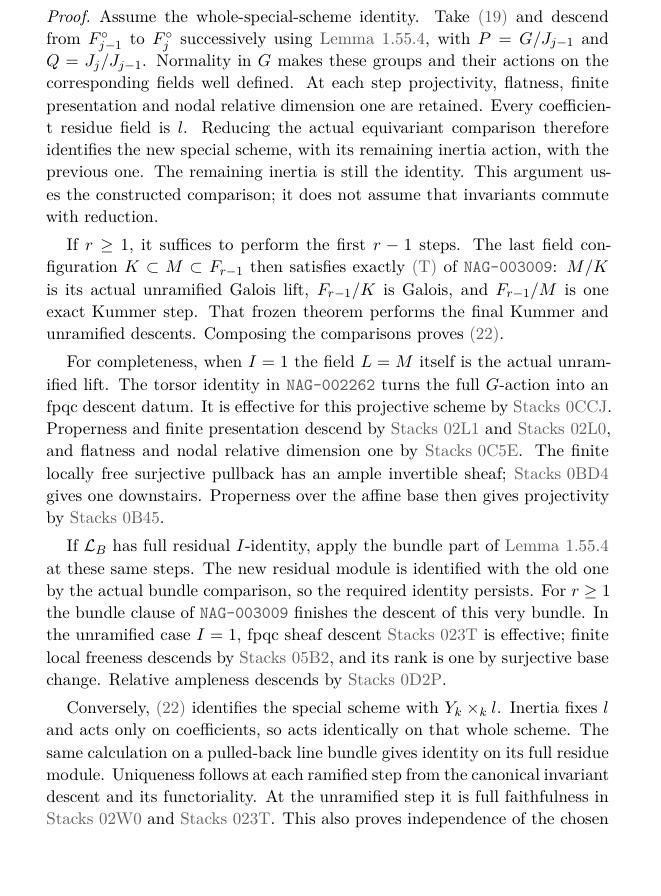
Typed proof inputs
- NAG-002262 · selected whole (explicit current dependencies)
- NAG-002610 · selected whole (explicit current dependencies)
- NAG-003008 · selected whole (explicit current dependencies)
- NAG-003009 · selected whole (explicit current dependencies)
- NAG-003145 · selected whole (explicit current dependencies)
- NAG-003146 · selected whole (explicit current dependencies)
Proof map
Verified map inputs · NAG-003147
AND · joint registered proof inputs
- NAG-002262 · Integral Galois descent for unramified coefficients · accepted whole
- NAG-002610 · Character modules give an exact integral test · accepted whole
- NAG-003008 · Result H.0.1 · accepted whole
- NAG-003009 · Result H.0.2 · accepted whole
- NAG-003145 · A Galois-normal sequence of exact Kummer steps · accepted whole
- NAG-003146 · Result G.0.25 · accepted whole
NAG-003147 · The full tame inertia criterion for a supplied model · Chapter argument