NAG-002374 · Accepted whole
The exceptional image of a generically free module
5 Tropicalization, multiplicities and balancing
Open in the English reader · PDF page 1003
Statement · exact TeX
\begin{theorem}[The exceptional image of a generically free module]
\label{v037:degree:exceptionalimage}
Let $Y=\mathcal M(A)$ be nonempty and pure of analytic
dimension $d$, and let $I\subset A$ be an ideal contained
in no minimal prime. Put $Z=\mathcal M(A/I)$, with its
actual closed-subspace structure. If $d=0$, then $Z$ is
empty. If $Z$ is nonempty, then
\[
                              \dim_K Z\leq d-1.
\]

For any unit tuple $f$ defining $t:Y\to\mathbb R^n$, the
entire actual image $t(Z)$ is the support of a finite
integral affine polyhedral complex of dimension at most
$d-1$; for $d=0$ it is empty.
Put $U_Y=\mathbb R^n\setminus t(\partial_KY)$.
The intersection $t(Z)\cap U_Y$ is relatively closed
in $t(Y)\cap U_Y$, and its complement is relatively
open and dense there.

In particular, let $M$ be a finite $A$-module which is free
at every minimal prime, and let $I_M$ define its nonfree
locus as in Proposition~\ref{v037:degree:freelocus}.
For every
\[
 w\in\bigl(t(Y)\cap U_Y\bigr)
                           \setminus t(\mathcal M(A/I_M)),
\]
there is a closed moment box $P$ about $w$ such that the
whole domain $Y_P=t^{-1}(P)$ is in the analytic free locus
and $M\otimes_A\mathcal O(Y_P)$ is finite locally free.
If $A$ is integral and the generic rank of $M$ is $r$, this
local rank is constantly $r$ on $\operatorname{Spec}\mathcal O(Y_P)$.
These conclusions apply to every finite module over reduced
$A$. For a finite algebra $M=B$, the corresponding actual
finite map over $Y_P$ is finite locally free, with the
same constant rank in the integral-target case.
\end{theorem}
Full selected proof · exact TeX
\begin{proof}
The finite quotient $A/I$ has its actual generalized
affinoid structure by
Theorem~\ref{fnd:generalizedfinitealgebras}.
Choose a free-radius extension $L=K_s$ making $A$ and $A/I$
strict, by Theorem~\ref{fnd:simultaneousstrictification}.
The quotient comparison of
Theorem~\ref{fnd:freeextensionfaithfullyflat} gives
\[
                          (A/I)_L=A_L/IA_L.
\]
Lemma~\ref{v036:analytic:freecomponents} identifies the
minimal primes of $A_L$ with $\mathfrak pA_L$ for
$\mathfrak p\in\operatorname{Min}(A)$, and their
contractions are $\mathfrak p$.
Thus $IA_L$ is contained in no minimal prime of $A_L$.
The analytic-dimension theorem
\ref{fnd:analyticdimensionindependence} gives
$\dim A_L=d$, since $A_L$ is strict.

Every chain of primes of $A_L/IA_L$ lifts to a chain
$\mathfrak q_0\subsetneq\cdots\subsetneq\mathfrak q_\ell$
of primes of $A_L$ containing $IA_L$.
By \cite[Tag 00E0(4)]{StacksAlg} applied to the zero ideal
in $A_L$ and the prime $\mathfrak q_0$, there is a minimal
prime $\mathfrak p_L\subseteq\mathfrak q_0$ of $A_L$.
The inclusion $\mathfrak p_L\subset\mathfrak q_0$ is
strict, because $IA_L$ is not contained in $\mathfrak p_L$.
Prepending $\mathfrak p_L$ therefore gives a chain of
length $\ell+1$ in $A_L$. Hence $\ell+1\leq d$.
Put $R=A_L/IA_L$. If $R\ne0$, then
\cite[Tag 00E0(2)]{StacksAlg} gives a maximal ideal
$\mathfrak m$ of $R$. The quotient $R/\mathfrak m$ is a field,
so $\mathfrak m$ is prime. There is thus a chain of length zero
in this case, and the bound on all chains gives $\dim R\leq d-1$.
The quotient is zero when $d=0$. The faithful quotient
comparison detects zero before extension, and
Theorem~\ref{fnd:analyticdimensionindependence} identifies
the dimension of every nonzero quotient with that of
$\mathcal M(A/I)$ over the original $K$.

If $Z$ is empty, its image has the empty complex.
Otherwise apply Theorem~\ref{v037:globaltrop:finiteimage}
to $Z$ and the restrictions of the original units.
The dimension inequality just proved gives the asserted
finite complex of dimension at most $d-1$ for the entire
actual image. Compactness of $Z$ and its image,
Proposition~\ref{fnd:boundedspectrumcompact}, proves
relative closedness on $U_Y$.

At every point of $t(Y)\cap U_Y$,
Theorem~\ref{v037:analytic:interiorlocalstar} presents
the ambient actual image by a finite pure $d$-dimensional
fan.
The exceptional complex is contained in a finite union of
affine subspaces of dimension at most $d-1$.
No such finite union contains a relatively open part
of a $d$-cell.
For example, choose a line direction in its tangent plane
outside the finitely many proper direction subspaces;
the finite-polynomial construction in
Theorem~\ref{v037:analytic:wallbalance} supplies one.
Every short line segment in that direction meets each
excluded affine subspace at most once.
Since a pure finite complex is the closure of the union
of its maximal-cell interiors, this proves density of
the complement at every point. Openness follows from
the relative closedness already proved. For $d=0$ the
exceptional set is empty and the assertion is immediate.

For the module $M$, Proposition~\ref{v037:degree:freelocus}
makes $I_M$ an ideal avoiding every minimal prime, and
identifies its analytic zero set with the nonfree locus.
Its image under $t$ is compact. Choose a closed box $P$
about the given $w$, with $w$ in its interior, contained
in $U_Y$ and disjoint from that compact image.
The actual domain $Y_P$ is given by
Theorem~\ref{fnd:generalizedrationaluniversal}.
It lies entirely in the analytic free locus, so the
analytic restriction assertion of
Proposition~\ref{v037:degree:freelocus} makes the restricted
module finite locally free.

If $A$ is integral, a free basis of $M_{\mathfrak p}$ at
any prime of the free locus becomes a basis over
$\operatorname{Frac}(A)$ after further localization.
Its rank is therefore the same integer $r$ at every such
prime. The principal free bases in the proof of that
proposition consequently all have rank $r$. They base
change to the indicated cover of
$\operatorname{Spec}\mathcal O(Y_P)$, proving the
constant-rank assertion. Reduced $A$ has the required
generic freeness by the same proposition.
For a finite algebra $B$, finite base change and its
canonical complete norm, Proposition
\ref{fnd:generalizedfinitebasechange}, identify the
restricted algebra with $B\otimes_A\mathcal O(Y_P)$.
The module assertion is exactly finite local freeness
of this actual morphism.
\end{proof}
Typeset reader excerpt
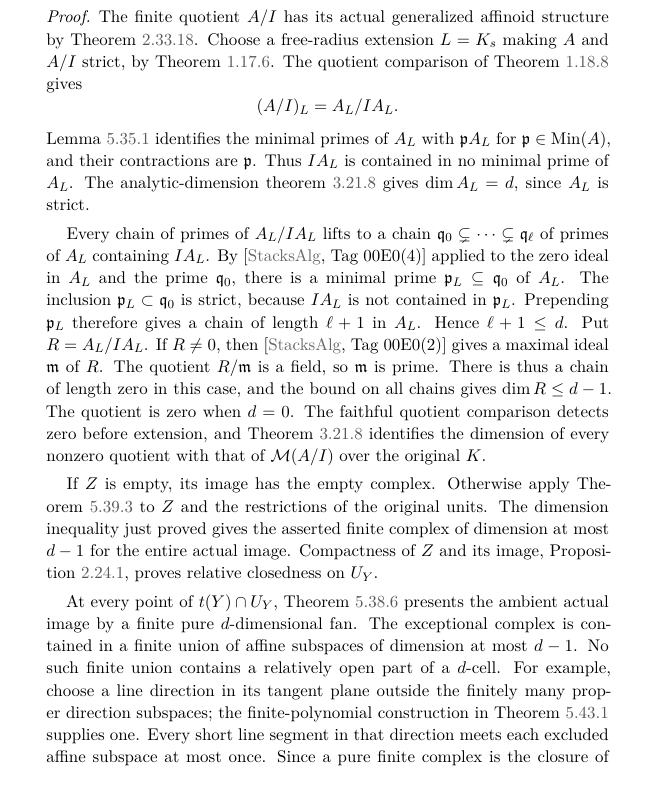
Typed proof inputs
- APP-STACKS-00E0@NAG-002374:nonzero-quotient-maximal-ideal · named external application
- APP-STACKS-00E0@NAG-002374:strict-prime-below · named external application
- NAG-001496 · selected whole
- NAG-001557 · selected whole
- NAG-001562 · selected whole
- NAG-001566 · selected whole
- NAG-001577 · selected whole
- NAG-001664 · selected whole
- NAG-001701 · selected whole
- NAG-001702 · selected whole
- NAG-002291 · selected whole
- NAG-002353 · selected whole
- NAG-002358 · selected whole
- NAG-002367 · selected whole
- NAG-002376 · selected whole
Named external registrations
Reader cross-references
Proof map
Verified map inputs · NAG-002374
AND · joint registered proof inputs
- NAG-001496 · Compactness of the bounded spectrum · accepted whole
- NAG-001557 · Simultaneous strictification of closed presentations · accepted whole
- NAG-001562 · Actual quotients by arbitrary ideals · accepted whole
- NAG-001566 · Free-radius extension is algebraically faithfully flat · accepted whole
- NAG-001577 · Bounded and geometric rational factorization · accepted whole
- NAG-001664 · Intrinsic analytic dimension and scalar extension · accepted whole
- NAG-001701 · Finite algebras with their canonical norm · accepted whole
- NAG-001702 · General finite base change · accepted whole
- NAG-002291 · Components under a free-radius extension · accepted whole
- NAG-002353 · The local tropical star of a whole interior fibre · accepted whole
- NAG-002358 · Global polyhedrality and the tropicalized boundary · accepted whole
- NAG-002367 · The free locus of a finite analytic module · accepted whole
- NAG-002376 · The normal equation at a polyhedral wall · accepted whole
Unlinked source pointers
These pointers have no operative linked edge in this map.
APP-STACKS-00E0@NAG-002374:nonzero-quotient-maximal-idealAPP-STACKS-00E0@NAG-002374:strict-prime-below
NAG-002374 · The exceptional image of a generically free module · Chapter argument