NAG-002440 · Accepted whole
The weak numerical conditions do not characterize vertices
Open in the English reader · PDF page 819
Statement · exact TeX
\begin{theorem}[The weak numerical conditions do not characterize vertices]
\label{v038:f5:wildnonmodelvertex}
Use $K$, $q$, $L$ and $\alpha$ from
Proposition~\ref{v038:f5:explicitimmediateextension}.
Let $J=G_L(Y)$ and put $X=\alpha+qY$ in $J$.
Restriction of this absolute value to $K(X)$ defines a point
$v\in(\mathbf P^1_K)^{\an}$ satisfying
\[
 \begin{aligned}
       \mathcal H(v)&=G_L(Y),\\
       |\mathcal H(v)^\times|&=|K^\times|,\qquad
       \widetilde{\mathcal H(v)}=\mathbf F_p(y).
 \end{aligned}
\]
Nevertheless $v$ is not a component vertex of any semistable
algebraic model over the original $K^\circ$ in
Definition~\ref{v036:f5:modelclass}.

The actual rational Gauss coordinate
\[
                         u=\frac{X^p-X-q^{-1}}q
\]
has $|u(v)|=1$ and residue $-y$, and $K(X)/K(u)$ is finite
separable. Its completed extension satisfies
\[
           [\mathcal H(v):G_K(u)]=p,
           \qquad [\widetilde{\mathcal H(v)}:\mathbf F_p(\bar u)]=1.
\]
Thus the obstruction occurs on a curve which already has the
smooth original model $\mathbf P^1_{K^\circ}$.
\end{theorem}
Full selected proof · exact TeX
\begin{proof}
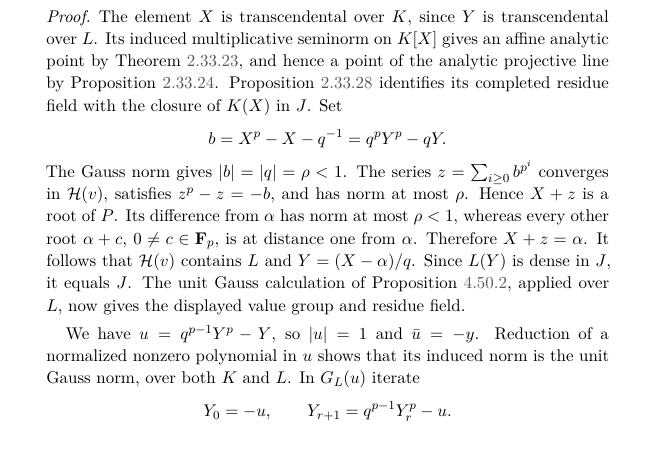
The element $X$ is transcendental over $K$, since $Y$ is
transcendental over $L$. Its induced multiplicative seminorm on
$K[X]$ gives an affine analytic point by
Theorem~\ref{fnd:affineanalytificationconstruction}, and hence a
point of the analytic projective line by
Proposition~\ref{fnd:analytificationzariskiopens}.
Proposition~\ref{fnd:analytificationvaluedfibres} identifies its
completed residue field with the closure of $K(X)$ in $J$.
Set
\[
                  b=X^p-X-q^{-1}=q^pY^p-qY.
\]
The Gauss norm gives $|b|=|q|=\rho<1$.
The series $z=\sum_{i\geq0}b^{p^i}$ converges in
$\mathcal H(v)$, satisfies $z^p-z=-b$, and has norm at most
$\rho$. Hence $X+z$ is a root of $P$. Its difference from
$\alpha$ has norm at most $\rho<1$, whereas every other root
$\alpha+c$, $0\ne c\in\mathbf F_p$, is at distance one from
$\alpha$. Therefore $X+z=\alpha$.
It follows that $\mathcal H(v)$ contains $L$ and
$Y=(X-\alpha)/q$. Since $L(Y)$ is dense in $J$, it equals $J$.
The unit Gauss calculation of
Proposition~\ref{v037:f5:integralgaussdegree}, applied over $L$,
now gives the displayed value group and residue field.

We have $u=q^{p-1}Y^p-Y$, so $|u|=1$ and $\bar u=-y$.
Reduction of a normalized nonzero polynomial in $u$ shows that
its induced norm is the unit Gauss norm, over both $K$ and $L$.
In $G_L(u)$ iterate
\[
                   Y_0=-u,\qquad Y_{r+1}=q^{p-1}Y_r^p-u.
\]
All iterates have norm at most one. Their successive differences
decrease to zero, since the map has Lipschitz constant at most
$|q|^{p-1}<1$ on that ball. The element $Y\in J$ is its fixed
point, and the same estimate shows $Y_r\to Y$ in $J$.
The complete subfield $G_L(u)$ is closed, so it contains $Y$.
Consequently $J=G_L(u)$, and
Lemma~\ref{v038:f5:finitegaussconstants} gives
$[J:G_K(u)]=[L:K]=p$.
The residual degree is one because $\bar u=-y$.
The equation $X^p-X-q^{-1}-qu=0$ makes $K(X)/K(u)$ finite,
and its derivative $-1$ makes the extension separable.

It remains to exclude all original models, not just this
particular coordinate. Choose the comparison field $\Omega$
of Lemma~\ref{v036:f5:comparisonfield}, using an algebraic
closure containing $L$. For every $c\in\mathbf F_p$ let $w_c$
be the Gauss point over $\Omega$ of the disc
\[
                         |X-(\alpha+c)|\leq|q|.
\]
The map $\alpha\mapsto\alpha+c$ defines a $K$-automorphism of
$L$, and is isometric by Lemma~\ref{fnd:finiteextensionnorms}.
Applied coefficientwise to any polynomial in $K[X]$, it shows
that every $w_c$ restricts to $v$.
These points are distinct: at $w_c$, the function
$X-(\alpha+c)$ has norm $|q|$, while at $w_{c'}$ for
$c'\ne c$ it has norm one.

Suppose $v$ were a model component vertex, with special component
$E$. Proposition~\ref{v036:f5:vertexarithmetic} gives
$k(E)=\mathbf F_p(y)$ and identifies the entire geometric
inverse image of $v$ with the component generic points above $E$.
That set has one element. Indeed,
\[
              \mathbf F_p(y)\otimes_{\mathbf F_p}
                           \overline{\mathbf F}_p
                         =\overline{\mathbf F}_p(y)
\]
is a field. To verify the equality, every finite coefficient
extension $k'/\mathbf F_p$ stays linearly independent over
$\mathbf F_p(y)$, by clearing polynomial denominators.
The tensor with $k'$ is therefore a finite-dimensional domain
and hence a field; it contains the inverses of all nonzero
polynomials with coefficients in $k'$. Taking the union over
these finite coefficient fields proves the equality.
The comparison-field residue is $\overline{\mathbf F}_p$ by
Lemma~\ref{v036:f5:comparisonfield}.
The $p$ distinct points $w_c$ above $v$ contradict this
singleton-fibre conclusion. Thus no such original model can
have $v$ as a component vertex.
Finally, the standard model $\mathbf P^1_{K^\circ}$ has its
two polynomial affine charts, flat by the coefficientwise ideal
criterion \cite[Tag 00HD]{StacksAlg} and smooth with their
displayed coordinates. It is projective and its special fibre
is the geometrically integral projective line. It belongs to
the stated model category.
\end{proof}
Typeset reader excerpt
Typed proof inputs
- NAG-000182 · selected whole
- NAG-000464 · selected whole
- NAG-001450 · selected whole
- NAG-001707 · selected whole
- NAG-001708 · selected whole
- NAG-001712 · selected whole
- NAG-002270 · selected whole
- NAG-002271 · selected whole
- NAG-002438 · selected whole
- NAG-002439 · selected whole
- NAG-000182 · selected whole (requires)
- NAG-000464 · selected whole (requires)
- NAG-001450 · selected whole (requires)
- NAG-001707 · selected whole (requires)
- NAG-001708 · selected whole (requires)
- NAG-001712 · selected whole (requires)
- NAG-002270 · selected whole (requires)
- NAG-002271 · selected whole (requires)
- NAG-002438 · selected whole (requires)
- NAG-002439 · selected whole (requires)
Reader cross-references
Proof map
Verified map inputs · NAG-002440
AND · joint registered proof inputs
- NAG-000182 · Multiplicativity of the weighted Gauss norm · accepted whole
- NAG-000464 · Result 3.8.1 · accepted whole
- NAG-001450 · Finite-dimensional norms and finite field extensions · accepted whole
- NAG-001707 · Affine analytification and its mapping property · accepted whole
- NAG-001708 · Principal opens and global analytification · accepted whole
- NAG-001712 · Residue fields, algebraic fibres and surjectivity · accepted whole
- NAG-002270 · An algebraically closed comparison field · accepted whole
- NAG-002271 · The arithmetic of a model vertex · accepted whole
- NAG-002438 · Finite constant extensions of a Gauss field · accepted whole
- NAG-002439 · Result 4.55.2 · accepted whole
NAG-002440 · The weak numerical conditions do not characterize vertices · Chapter argument