NAG-002458 · Accepted whole
The finite locus at maximal-dimensional analytic points
5 Tropicalization, multiplicities and balancing
Open in the English reader · PDF page 1065
Statement · exact TeX
\begin{theorem}[The finite locus at maximal-dimensional analytic points]
\label{v038:degree:properfinitelocus}
Let $p:X\to Y$ be a proper morphism of good Hausdorff analytic
spaces, with $\dim_K X\leq d$. If $y\in Y$ satisfies
$d_K(y)=d$, then its entire analytic fibre is finite, and
$p$ is finite over an ordinary neighbourhood of $y$.
If $Y$ is pure of analytic dimension $d$, the ordinary
finite-fibre locus is open and dense in $Y$.
\end{theorem}
Full selected proof · exact TeX
\begin{proof}
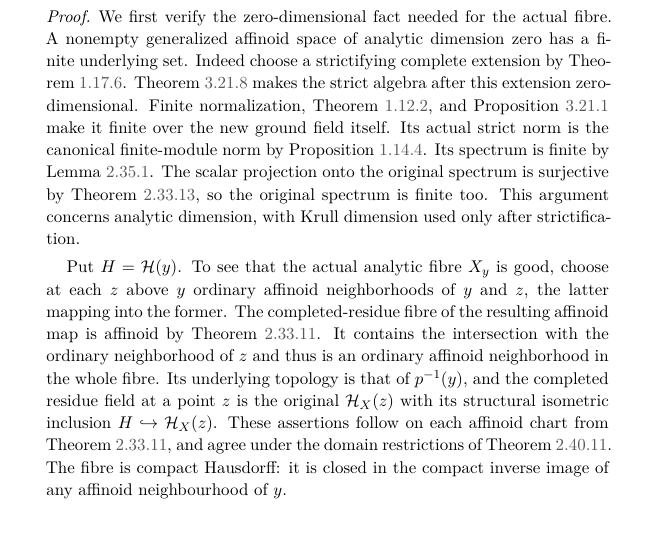
We first verify the zero-dimensional fact needed for the
actual fibre. A nonempty generalized affinoid space of
analytic dimension zero has a finite underlying set.
Indeed choose a strictifying complete extension by
Theorem~\ref{fnd:simultaneousstrictification}.
Theorem~\ref{fnd:analyticdimensionindependence} makes the
strict algebra after this extension zero-dimensional.
Finite normalization, Theorem~\ref{fnd:strictfinitenormalization},
and Proposition~\ref{fnd:stricttatedimension} make it finite
over the new ground field itself. Its actual strict norm is
the canonical finite-module norm by
Proposition~\ref{fnd:strictfinitealgebras}. Its spectrum is
finite by Lemma~\ref{fnd:finiteanalyticbranchseparation}.
The scalar projection onto the original spectrum is
surjective by Theorem~\ref{fnd:scalarextensionspectralsurjective},
so the original spectrum is finite too. This argument concerns
analytic dimension, with Krull dimension used only after
strictification.

Put $H=\mathcal H(y)$. To see that the actual analytic fibre $X_y$ is good, choose
at each $z$ above $y$ ordinary affinoid neighborhoods of $y$
and $z$, the latter mapping into the former. The completed-residue
fibre of the resulting affinoid map is affinoid by
Theorem~\ref{fnd:allpointaffinoidfibres}. It contains the
intersection with the ordinary neighborhood of $z$ and thus is an
ordinary affinoid neighborhood in the whole fibre.
Its underlying topology is that of $p^{-1}(y)$, and the
completed residue field at a point $z$ is the original
$\mathcal H_X(z)$ with its structural isometric inclusion
$H\hookrightarrow\mathcal H_X(z)$. These assertions follow
on each affinoid chart from
Theorem~\ref{fnd:allpointaffinoidfibres}, and agree under the
domain restrictions of Theorem~\ref{fnd:generalanalyticproducts}.
The fibre is compact Hausdorff: it is closed in the compact
inverse image of any affinoid neighbourhood of $y$.

For every point $z$ in this fibre, the valued-field tower
formula, Lemma~\ref{fnd:valuedfielddimensioncalculus}, gives
\[
 d_H(z)=d_K(z)-d_K(y)\leq\dim_K X-d\leq0.
\]
Here the point-dimension bound is
Theorem~\ref{fnd:generalanalyticabhyankar}, and $d_H(z)$ is
nonnegative. It is consequently zero. The maximum formula
of Theorem~\ref{fnd:affinoidabhyankarmaximum} makes every
nonempty affinoid chart of $X_y$ zero-dimensional over $H$.
Compactness supplies finitely many such charts, each with a
finite underlying set by the first paragraph. Thus the
entire fibre is finite. Properness supplies relative
interiority of all its points, so
Lemma~\ref{v038:degree:wholefinitefibre} gives the asserted
ordinary finite neighbourhood, including the empty-fibre case.

If $Y$ is pure of dimension $d$, every nonempty ordinary
open subset contains a nonempty affinoid neighbourhood
$V$ of dimension $d$, by goodness and
Lemma~\ref{v037:integration:puritylocality}.
The Abhyankar maximum formula supplies a point of $V$
with $d_K(y)=d$. Corollary~\ref{fnd:domainresiduefields}
leaves its completed residue field unchanged under domain
restriction, so it is a point of the finite
locus just proved. That locus therefore meets every
nonempty ordinary open subset. Its openness is
Lemma~\ref{v038:degree:wholefinitefibre}, proving density.
\end{proof}
Typeset reader excerpt
Typed proof inputs
- NAG-001451 · selected whole (selected native whole)
- NAG-001483 · selected whole (selected native whole)
- NAG-001496 · selected whole (selected native whole)
- NAG-001557 · selected whole (selected native whole)
- NAG-001586 · selected whole, export unavailable (selected native whole)
- NAG-001591 · selected whole (selected native whole)
- NAG-001593 · selected whole (selected native whole)
- NAG-001615 · selected whole (selected native whole)
- NAG-001617 · selected whole (selected native whole)
- NAG-001657 · selected whole (selected native whole)
- NAG-001664 · selected whole (selected native whole)
- NAG-001692 · selected whole (selected native whole)
- NAG-001694 · selected whole (selected native whole)
- NAG-001697 · selected whole (selected native whole)
- NAG-001735 · selected whole (selected native whole)
- NAG-002413 · selected whole (selected native whole)
- NAG-002457 · selected whole (selected native whole)
Reader cross-references
- fnd:affinoidabhyankarmaximum
- fnd:allpointaffinoidfibres
- fnd:analyticdimensionindependence
- fnd:domainresiduefields
- fnd:finiteanalyticbranchseparation
- fnd:generalanalyticabhyankar
- fnd:generalanalyticproducts
- fnd:scalarextensionspectralsurjective
- fnd:strictfinitealgebras
- fnd:strictfinitenormalization
- fnd:stricttatedimension
- v037:integration:puritylocality
- v038:degree:wholefinitefibre
Proof map
Verified map inputs · NAG-002458
AND · joint registered proof inputs
- NAG-001451 · Finite normalization for strict affinoid algebras · accepted whole Exact source window 101–118
- Strictify the actual zero-dimensional affinoid with its original underlying analytic dimension preserved. Its strict algebra is finite with canonical norm, so it has a finite spectrum. Use actual scalar spectral surjectivity to descend finiteness of the point set.
- NAG-001483 · The affinoid norm on a finite algebra · accepted whole Exact source window 101–118
- Strictify the actual zero-dimensional affinoid with its original underlying analytic dimension preserved. Its strict algebra is finite with canonical norm, so it has a finite spectrum. Use actual scalar spectral surjectivity to descend finiteness of the point set.
- NAG-001496 · Compactness of the bounded spectrum · accepted whole Exact source window 120–135
- Construct the same actual completed-residue fibre and its local affinoid neighbourhoods directly from good source and target ordinary charts. The fibre subspace topology makes each ordinary neighbourhood intersect in an ordinary fibre neighbourhood. Properness gives compact Hausdorffness of the whole fibre. No universal good-space properness criterion is consumed here.
- NAG-001557 · Simultaneous strictification of closed presentations · accepted whole Exact source window 101–118
- Strictify the actual zero-dimensional affinoid with its original underlying analytic dimension preserved. Its strict algebra is finite with canonical norm, so it has a finite spectrum. Use actual scalar spectral surjectivity to descend finiteness of the point set.
- NAG-001586 · Result 3.22.2 · accepted whole; PDF destination Exact source window 137–152
- At every point of the entire analytic fibre, the valued-field tower formula and original source dimension bound force analytic dimension zero over the actual completed residue field. Compactness gives finitely many affinoid fibre charts, each finite by the first paragraph. Apply the selected full-fibre lemma with proper innerness, including an empty fibre.
- NAG-001591 · Dimension as a maximum over analytic points · accepted whole Exact source windows 137–152, 154–164
- At every point of the entire analytic fibre, the valued-field tower formula and original source dimension bound force analytic dimension zero over the actual completed residue field. Compactness gives finitely many affinoid fibre charts, each finite by the first paragraph. Apply the selected full-fibre lemma with proper innerness, including an empty fibre.
- Every nonempty ordinary open in the pure good target contains a nonempty affinoid neighbourhood of dimension d, so its Abhyankar maximum gives such an analytic point with unchanged completed residue field. This gives density and the whole-fibre lemma gives openness.
- NAG-001593 · Local analytic dimension and the Abhyankar inequality · accepted whole Exact source window 137–152
- At every point of the entire analytic fibre, the valued-field tower formula and original source dimension bound force analytic dimension zero over the actual completed residue field. Compactness gives finitely many affinoid fibre charts, each finite by the first paragraph. Apply the selected full-fibre lemma with proper innerness, including an empty fibre.
- NAG-001615 · Fibre products of analytic spaces · accepted whole Exact source window 120–135
- Construct the same actual completed-residue fibre and its local affinoid neighbourhoods directly from good source and target ordinary charts. The fibre subspace topology makes each ordinary neighbourhood intersect in an ordinary fibre neighbourhood. Properness gives compact Hausdorffness of the whole fibre. No universal good-space properness criterion is consumed here.
- NAG-001617 · Points and fibres on general analytic spaces · accepted whole Exact source window 120–135
- Construct the same actual completed-residue fibre and its local affinoid neighbourhoods directly from good source and target ordinary charts. The fibre subspace topology makes each ordinary neighbourhood intersect in an ordinary fibre neighbourhood. Properness gives compact Hausdorffness of the whole fibre. No universal good-space properness criterion is consumed here.
- NAG-001657 · Dimension of a strict normalization · accepted whole Exact source window 101–118
- Strictify the actual zero-dimensional affinoid with its original underlying analytic dimension preserved. Its strict algebra is finite with canonical norm, so it has a finite spectrum. Use actual scalar spectral surjectivity to descend finiteness of the point set.
- NAG-001664 · Intrinsic analytic dimension and scalar extension · accepted whole Exact source window 101–118
- Strictify the actual zero-dimensional affinoid with its original underlying analytic dimension preserved. Its strict algebra is finite with canonical norm, so it has a finite spectrum. Use actual scalar spectral surjectivity to descend finiteness of the point set.
- NAG-001692 · Affinoid fibres at all Berkovich points · accepted whole Exact source window 120–135
- Construct the same actual completed-residue fibre and its local affinoid neighbourhoods directly from good source and target ordinary charts. The fibre subspace topology makes each ordinary neighbourhood intersect in an ordinary fibre neighbourhood. Properness gives compact Hausdorffness of the whole fibre. No universal good-space properness criterion is consumed here.
- NAG-001694 · Surjectivity after an arbitrary complete extension · accepted whole Exact source window 101–118
- Strictify the actual zero-dimensional affinoid with its original underlying analytic dimension preserved. Its strict algebra is finite with canonical norm, so it has a finite spectrum. Use actual scalar spectral surjectivity to descend finiteness of the point set.
- NAG-001697 · Completed residue fields on affinoid domains · accepted whole Exact source windows 120–135, 154–164
- Construct the same actual completed-residue fibre and its local affinoid neighbourhoods directly from good source and target ordinary charts. The fibre subspace topology makes each ordinary neighbourhood intersect in an ordinary fibre neighbourhood. Properness gives compact Hausdorffness of the whole fibre. No universal good-space properness criterion is consumed here.
- Every nonempty ordinary open in the pure good target contains a nonempty affinoid neighbourhood of dimension d, so its Abhyankar maximum gives such an analytic point with unchanged completed residue field. This gives density and the whole-fibre lemma gives openness.
- NAG-001735 · Separating the branches of a finite morphism · accepted whole Exact source window 101–118
- Strictify the actual zero-dimensional affinoid with its original underlying analytic dimension preserved. Its strict algebra is finite with canonical norm, so it has a finite spectrum. Use actual scalar spectral surjectivity to descend finiteness of the point set.
- NAG-002413 · Purity is local on affinoid covers · accepted whole Exact source window 154–164
- Every nonempty ordinary open in the pure good target contains a nonempty affinoid neighbourhood of dimension d, so its Abhyankar maximum gives such an analytic point with unchanged completed residue field. This gives density and the whole-fibre lemma gives openness.
- NAG-002457 · A finite neighbourhood of the entire analytic fibre · accepted whole Exact source windows 137–152, 154–164
- At every point of the entire analytic fibre, the valued-field tower formula and original source dimension bound force analytic dimension zero over the actual completed residue field. Compactness gives finitely many affinoid fibre charts, each finite by the first paragraph. Apply the selected full-fibre lemma with proper innerness, including an empty fibre.
- Every nonempty ordinary open in the pure good target contains a nonempty affinoid neighbourhood of dimension d, so its Abhyankar maximum gives such an analytic point with unchanged completed residue field. This gives density and the whole-fibre lemma gives openness.
NAG-002458 · The finite locus at maximal-dimensional analytic points · Chapter argument