NAG-002563 · Accepted whole
Weak end-cycle identity; F8LA-P3R
I Descent of the polarized mixed tower
Open in the English reader · PDF page 2113
Statement · exact TeX
\begin{theorem}[Weak end-cycle identity; F8LA-P3R]\label{thm:weak}
For every \(\eta\in\A_c^{n-1,n-1}(W)\), extended by zero outside \(W\),
\[
 I_C\bigl((-t)\dd\pi^*\eta\bigr)
        =I_{\Dinf(C)}(\eta).
 \tag{3.1}
\]
The left side is absolutely convergent in the cell sense of
\cref{def:finite}.

Choose \(\rho\in C_c^\infty((0,1))\), \(\rho\geq0\),
\(\int\rho=1\), and define
\[
 h_R(t)=-t+\int_{\R}(t-R-s)_+\rho(s)\,ds.
 \tag{3.2}
\]
Then \(h_R=-t\) for \(t\leq R\),
\(h_R=-R-\mu\) for \(t\geq R+1\), where
\(\mu=\int s\rho(s)\,ds\), and \(h_R''=\rho(t-R)\).
For \(R\geq H\),
\[
 I_C\bigl(\dd h_R\wedge\pi^*\eta\bigr)
       =I_{\Dinf(C)}(\eta).
 \tag{3.3}
\]
Thus these pairings stabilize exactly, on this prescribed class of tests.
\end{theorem}
Full selected proof · exact TeX
\begin{proof}
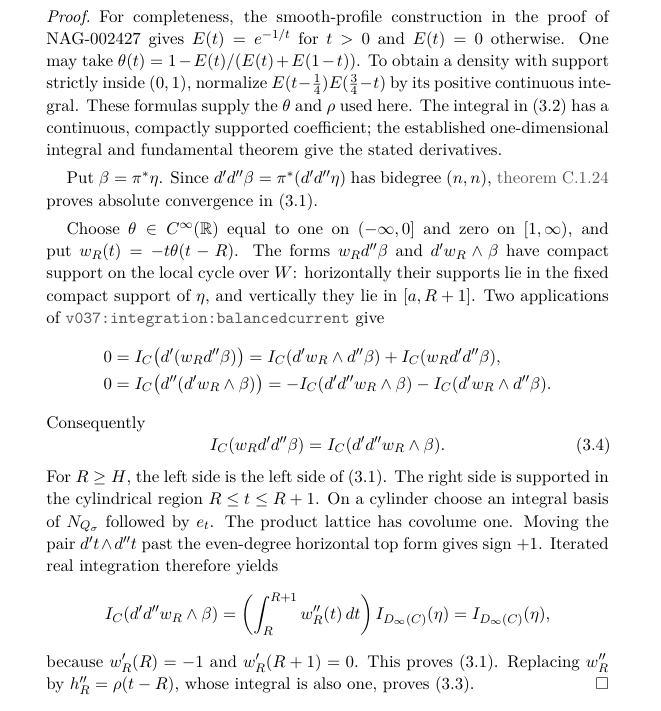
For completeness, the smooth-profile construction in the proof of
NAG-002427 gives \(E(t)=e^{-1/t}\) for \(t>0\) and \(E(t)=0\) otherwise.
One may take
\(\theta(t)=1-E(t)/(E(t)+E(1-t))\).
To obtain a density with support strictly inside \((0,1)\), normalize
\(E(t-\tfrac14)E(\tfrac34-t)\) by its positive continuous integral.
These formulas supply the \(\theta\) and \(\rho\) used here.
The integral in (3.2) has a continuous, compactly supported coefficient;
the established one-dimensional integral and fundamental theorem give
the stated derivatives.

Put \(\beta=\pi^*\eta\). Since
\(\dd\beta=\pi^*(\dd\eta)\) has bidegree \((n,n)\),
\cref{thm:estimate} proves absolute convergence in (3.1).

Choose \(\theta\in C^\infty(\R)\) equal to one on
\((-\infty,0]\) and zero on \([1,\infty)\), and put
\(w_R(t)=-t\theta(t-R)\).
The forms \(w_Rd''\beta\) and \(d'w_R\wedge\beta\)
have compact support on the local cycle over \(W\): horizontally their
supports lie in the fixed compact support of \(\eta\), and vertically
they lie in \([a,R+1]\). Two applications of
\tagname{v037:integration:balancedcurrent} give
\begin{align*}
 0&=I_C\bigl(d'(w_Rd''\beta)\bigr)
     =I_C(d'w_R\wedge d''\beta)+I_C(w_R\dd\beta),\\
 0&=I_C\bigl(d''(d'w_R\wedge\beta)\bigr)
     =-I_C(\dd w_R\wedge\beta)-I_C(d'w_R\wedge d''\beta).
\end{align*}
Consequently
\[
 I_C(w_R\dd\beta)=I_C(\dd w_R\wedge\beta).
 \tag{3.4}
\]
For \(R\geq H\), the left side is the left side of (3.1).
The right side is supported in the cylindrical region
\(R\leq t\leq R+1\). On a cylinder choose an integral basis
of \(N_{Q_\sigma}\) followed by \(e_t\).
The product lattice has covolume one. Moving the pair
\(d't\wedge d''t\) past the even-degree horizontal top form gives
sign \(+1\). Iterated real integration therefore yields
\[
 I_C(\dd w_R\wedge\beta)
 =\left(\int_R^{R+1}w_R''(t)\,dt\right)
                   I_{\Dinf(C)}(\eta)
 = I_{\Dinf(C)}(\eta),
\]
because \(w_R'(R)=-1\) and \(w_R'(R+1)=0\).
This proves (3.1). Replacing \(w_R''\) by
\(h_R''=\rho(t-R)\), whose integral is also one, proves (3.3).
\end{proof}
Typeset reader excerpt
Typed proof inputs
- NAG-002384 · typed target unresolved in this export (definition)
- NAG-002388 · typed target unresolved in this export (definition)
- NAG-002389 · selected whole (whole)
- NAG-002391 · selected whole (whole)
- NAG-002427 · selected whole (whole)
- NAG-002561 · selected whole (whole)
- NAG-002562 · selected whole (whole)
- NAG-002389 · selected whole (explicit current dependencies)
- NAG-002391 · selected whole (explicit current dependencies)
- NAG-002427 · selected whole (explicit current dependencies)
- NAG-002561 · selected whole (explicit current dependencies)
- NAG-002562 · selected whole (explicit current dependencies)
Reader cross-references
Proof map
Verified map inputs · NAG-002563
AND · joint registered proof inputs
- NAG-002389 · The real polyhedral integration calculation · accepted whole
- Exact finite continuous lattice integration and product implementation on the invariant saturated bases.
- NAG-002391 · Integration and closedness of a local balanced cycle · accepted whole
- Two compact exterior Stokes tests on the supplied balanced local graph in the open W; includes prescribed exposed lower and side faces.
- NAG-002427 · Compact smooth cutoffs · accepted whole
- Explicit real smooth profile only.
- NAG-002561 · Eventual cylinders; F8LA-P1 · accepted whole
- Eventual cylinders and index-one product lattice.
- NAG-002562 · Uniform top-degree excision; F8LA-P2R · accepted whole
- Excision and absolute convergence for the actual finite graph.
Unlinked source pointers
These pointers have no operative linked edge in this map.
NAG-002384NAG-002388
NAG-002563 · Weak end-cycle identity; F8LA-P3R · Chapter argument