NAG-002600 · Accepted whole
Exact arithmetic subdivisions
F Descent of an algebraized polarized tower
Open in the English reader · PDF page 1985
Statement · exact TeX
\begin{theorem}[Exact arithmetic subdivisions]
\label{cand:f5sub:exactsubdivision}
Every compatible cut datum \(S=(S_e)\) has a model \(\mathcal X[S]\),
preserving \(D\), with geometric vertices exactly
\[
 p^{-1}(V(\mathcal X))\ \cup\
       \bigcup_e\{\zeta_e(\exp(-s)):s\in S_e\}.             \tag{*}
\]
It dominates \(\mathcal X\) and is unique up to the unique marked
generic-identity isomorphism. It is independent of the splitting
field and coordinates when the prescribed analytic points are fixed.

If \(S_e\subset T_e\) for all \(e\), there is a unique compatible
morphism \(\mathcal X[T]\to\mathcal X[S]\).
The model \(\mathcal X[S\cup T]\) is the least common dominating
model of \(\mathcal X[S]\) and \(\mathcal X[T]\), even among models
with vertices outside the original skeleton.
\end{theorem}
Full selected proof · exact TeX
\begin{proof}
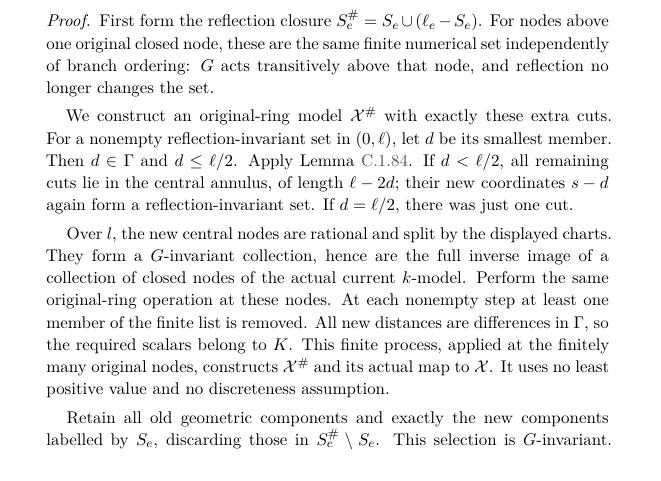
First form the reflection closure
\(S_e^\#=S_e\cup(\ell_e-S_e)\).
For nodes above one original closed node, these are the same finite
numerical set independently of branch ordering: \(G\) acts
transitively above that node, and reflection no longer changes
the set.

We construct an original-ring model \(\mathcal X^\#\) with exactly
these extra cuts. For a nonempty reflection-invariant set in
\((0,\ell)\), let \(d\) be its smallest member.
Then \(d\in\Gamma\) and \(d\leq\ell/2\).
Apply Lemma~\ref{cand:f5sub:originalsymmetric}.
If \(d<\ell/2\), all remaining cuts lie in the central annulus,
of length \(\ell-2d\); their new coordinates \(s-d\) again form a
reflection-invariant set. If \(d=\ell/2\), there was just one cut.

Over \(l\), the new central nodes are rational and split by the
displayed charts. They form a \(G\)-invariant collection, hence
are the full inverse image of a collection of closed nodes of the
actual current \(k\)-model. Perform the same original-ring operation
at these nodes. At each nonempty step at least one member of the
finite list is removed. All new distances are differences in
\(\Gamma\), so the required scalars belong to \(K\).
This finite process, applied at the finitely many original nodes,
constructs \(\mathcal X^\#\) and its actual map to \(\mathcal X\).
It uses no least positive value and no discreteness assumption.

Retain all old geometric components and exactly the new components
labelled by \(S_e\), discarding those in \(S_e^\#\setminus S_e\).
This selection is \(G\)-invariant. The new components and their
attachment points are split over \(l\): they are the exceptional
projective lines in the accepted chart calculation, and the
pointed etale maps induce isomorphisms on the exceptional fibres.
Thus the action of \(\operatorname{Aut}(\overline k/k)\) on the new
components factors through \(\operatorname{Gal}(l/k)\).
All old geometric components are retained. The selection is
therefore invariant under the full residual action.
By \dep{v037:f5:geometriccomponentorbits}, it is the entire inverse
image of a subset \(V\subset V(\mathcal X^\#)\) of actual
original-field component vertices.

Each connected collection of discarded geometric components is a
chain of smooth projective lines with no marking and two attaching
branches on retained components. It cannot be a cycle: every
original edge has retained endpoints, including the retained old
vertex at both ends of a self-loop. If the two attaching branches
meet the same retained component, they are counted twice.
This is exactly the marked forest condition
\dep{v036:f5:forestcondition}, with \(b=2,m=0\).
The actual original-ring theorem \dep{v036:f5:markedcontraction}
now gives a projective model \(\mathcal X[S]\) with precisely (*).

All old vertices remain, so \dep{v037:f5:algebraicdomination} gives
\(\mathcal X[S]\to\mathcal X\).
That accepted theorem and \dep{v037:f5:intrinsicuniqueness}
also give uniqueness, marking compatibility and the morphisms for
\(S\subset T\). They prove independence of auxiliary choices,
using \dep{v036:f5:vertexarithmetic} to identify original vertex
sets from their entire geometric inverse images.

The union datum is compatible. Every model dominating both
\(\mathcal X[S]\) and \(\mathcal X[T]\) contains both vertex sets,
hence their union, which is \(V(\mathcal X[S\cup T])\).
Applying \dep{v037:f5:algebraicdomination} gives its unique morphism
to \(\mathcal X[S\cup T]\), as required.
\end{proof}
Typeset reader excerpt
Typed proof inputs
- NAG-002032 · selected whole (selected native whole)
- NAG-002053 · selected whole (selected native whole)
- NAG-002099 · selected whole (selected native whole)
- NAG-002220 · selected whole (selected native whole)
- NAG-002222 · selected whole (selected native whole)
- NAG-002262 · selected whole (selected native whole)
- NAG-002270 · selected whole (selected native whole)
- NAG-002271 · selected whole (selected native whole)
- NAG-002274 · selected whole (selected native whole)
- NAG-002311 · selected whole (selected native whole)
- NAG-002312 · selected whole (selected native whole)
- NAG-002326 · selected whole (selected native whole)
- NAG-002599 · selected whole (selected native whole)
Reader cross-references
Proof map
Verified map inputs · NAG-002600
AND · joint registered proof inputs
- NAG-002032 · Open annuli and their radial homotopies · accepted whole
- NAG-002053 · All lifts of a finite set of nodes · accepted whole
- NAG-002099 · A symmetric subdivision of a nodal annulus · accepted whole
- NAG-002220 · Result 4.39.1 · accepted whole
- NAG-002222 · Formal smooth and nodal tube closures · accepted whole
- NAG-002262 · Integral Galois descent for unramified coefficients · accepted whole
- NAG-002270 · An algebraically closed comparison field · accepted whole
- NAG-002271 · The arithmetic of a model vertex · accepted whole
- NAG-002274 · Exact marked contraction over the original field · accepted whole
- NAG-002311 · Algebraic domination from vertex inclusion · accepted whole
- NAG-002312 · Algebraic uniqueness without a supplied common model · accepted whole
- NAG-002326 · Geometric components over one original component · accepted whole
- NAG-002599 · An original-ring symmetric insertion · accepted whole
NAG-002600 · Exact arithmetic subdivisions · Chapter argument