NAG-002800 · Accepted whole
Finite maps become free along the section; F8RC-F
F Descent of an algebraized polarized tower
Open in the English reader · PDF page 1992
Statement · exact TeX
\begin{lemma}[Finite maps become free along the section; F8RC-F]
\label{lem:finiteflat}
Let \(F:Y\to Z\) be finite between good Hausdorff spaces pure of
analytic dimension \(n\). Suppose the ordinary local rings of \(Z\)
are regular, and every affinoid domain of \(Y\) has \(S_1\) algebra.
At every \(s\in Z\) with \(d_K(s)\geq n-1\), the finite coherent
module \(F_*\cO_Y\) is free on an ordinary neighbourhood of \(s\).
Rank zero is allowed when the fibre is empty.
\end{lemma}
Full selected proof · exact TeX
\begin{proof}
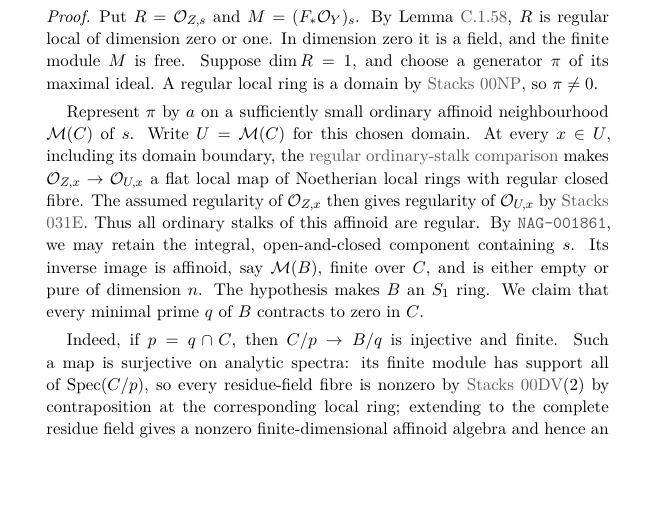
Put \(R=\cO_{Z,s}\) and \(M=(F_*\cO_Y)_s\). By
Lemma~\ref{lem:defect}, \(R\) is regular local of dimension zero or
one. In dimension zero it is a field, and the finite module \(M\) is
free. Suppose \(\dim R=1\), and choose a generator \(\pi\) of its
maximal ideal. A regular local ring is a domain by \href{https://stacks.math.columbia.edu/tag/00NP}{Stacks 00NP}, so \(\pi\ne0\).

Represent \(\pi\) by \(a\) on a sufficiently small ordinary affinoid
neighbourhood \(\cM(C)\) of \(s\). Write \(U=\cM(C)\) for this chosen domain. At every \(x\in U\),
including its domain boundary, the
\hyperref[fnd:analyticdomainordinaryregular]{regular ordinary-stalk comparison}
makes \(\cO_{Z,x}\to\cO_{U,x}\) a flat local map of Noetherian local rings
with regular closed fibre. The assumed regularity of \(\cO_{Z,x}\)
then gives regularity of \(\cO_{U,x}\) by
\href{https://stacks.math.columbia.edu/tag/031E}{Stacks 031E}.
Thus all ordinary stalks of this affinoid are regular. By \tagg{NAG-001861}, we may
retain the integral, open-and-closed component containing \(s\).
Its inverse image is affinoid, say \(\cM(B)\), finite over \(C\), and
is either empty or pure of dimension \(n\). The hypothesis makes
\(B\) an \(S_1\) ring. We claim that every minimal prime \(q\) of
\(B\) contracts to zero in \(C\).

Indeed, if \(p=q\cap C\), then \(C/p\to B/q\) is injective and
finite. Such a map is surjective on analytic spectra: its finite
module has support all of \(\Spec(C/p)\), so every residue-field
fibre is nonzero by \href{https://stacks.math.columbia.edu/tag/00DV}{Stacks 00DV}(2) by contraposition at the corresponding local ring; extending to the complete residue field gives a
nonzero finite-dimensional affinoid algebra and hence an analytic
point. Completed residue extensions at points of a finite map are
finite, by \tagg{NAG-001590}. The maximum formula
\tagg{NAG-001591} therefore gives
\[
 \dim_K\cM(C/p)=\dim_K\cM(B/q)=n.
\]
If \(p\ne0\), dimension drop (\hyperref[v037:degree:exceptionalimage]{NAG-002374}) in the integral pure \(n\)-dimensional
algebra \(C\) contradicts this equality. Thus \(p=0\).

The element \(a\) is nonzero in \(C\), since its germ is \(\pi\ne0\).
It avoids every minimal prime of \(B\), hence every associated prime,
because \(B\) is \(S_1\) by \href{https://stacks.math.columbia.edu/tag/031Q}{Stacks 031Q}, (2) implies (1). Multiplication by \(a\) on \(B\) is
injective. The ordinary comparison \(C\to R\) is flat
(\tagg{NAG-001698}, or \tagg{001782} after localization), and
\(M=B\otimes_C R\) by finite coherent restriction. Thus \(\pi\)
acts injectively on \(M\).

Lift a basis of \(M/\pi M\) to obtain \(R^r\to M\), surjective by
Nakayama (\href{https://stacks.math.columbia.edu/tag/00DV}{Stacks 00DV}(2) on the finite cokernel). Its kernel \(N\) is finite. The resolution
\(0\to R\xrightarrow{\pi}R\to R/(\pi)\to0\) and injectivity of
\(\pi\) on \(M\) give \(\operatorname{Tor}_1^R(M,R/(\pi))=0\).
Tensoring the presentation of \(M\) therefore gives \(N/\pi N=0\).
Nakayama gives \(N=0\) by \href{https://stacks.math.columbia.edu/tag/00DV}{Stacks 00DV}(2) on \(N\), proving that \(M\) is free.
Finally \tagg{NAG-001753} spreads the free stalk to an ordinary
neighbourhood. This proves actual local freeness, including its
analytic base changes; mere torsion-freeness over an unspecified
higher-dimensional ring has not been used.
\end{proof}
Typeset reader excerpt
Typed proof inputs
- STACKS-00DV · named external application
- STACKS-00NP · named external application
- STACKS-031E · named external application
- STACKS-031Q · named external application
- NAG-001560 · selected whole (selected native whole)
- NAG-001562 · selected whole (selected native whole)
- NAG-001572 · selected whole (selected native whole)
- NAG-001590 · selected whole (selected native whole)
- NAG-001591 · selected whole (selected native whole)
- NAG-001692 · selected whole (selected native whole)
- NAG-001698 · selected whole (selected native whole)
- NAG-001702 · selected whole (selected native whole)
- NAG-001752 · selected whole (selected native whole)
- NAG-001753 · selected whole (selected native whole)
- NAG-001792 · selected whole (selected native whole)
- NAG-001861 · selected whole (selected native whole)
- NAG-002374 · selected whole (selected native whole)
- NAG-002413 · selected whole (selected native whole)
- NAG-002799 · selected whole (selected native whole)
Reader cross-references
Proof map
Verified map inputs · NAG-002800
AND · joint registered proof inputs
- NAG-001560 · Closed submodules and controlled matrix images · accepted whole Exact source window 280–286
- NAG-001562 · Actual quotients by arbitrary ideals · accepted whole Exact source window 266–271
- NAG-001572 · Nonemptiness and the unit-ideal test · accepted whole Exact source window 266–271
- NAG-001590 · Completed residue fields of a finite morphism · accepted whole Exact source window 272–278
- NAG-001591 · Dimension as a maximum over analytic points · accepted whole Exact source window 272–278
- NAG-001692 · Affinoid fibres at all Berkovich points · accepted whole Exact source window 266–271
- NAG-001698 · Ordinary affinoid stalks · accepted whole Exact source windows 280–286, 258–263
- NAG-001702 · General finite base change · accepted whole Exact source windows 258–263, 266–271
- NAG-001752 · Coherent direct image under a finite morphism · accepted whole Exact source windows 280–286, 294–296
- NAG-001753 · A flat coherent ordinary stalk is locally free · accepted whole Exact source window 294–296
- NAG-001792 · Regular ordinary local maps of analytic domains · accepted whole Exact source window 258–263
- NAG-001861 · Regular affinoids and their components · accepted whole Exact source window 258–263
- NAG-002374 · The exceptional image of a generically free module · accepted whole Exact source window 272–278
- NAG-002413 · Purity is local on affinoid covers · accepted whole Exact source window 258–263
- NAG-002799 · Ordinary local dimension bound; F8RC-D · accepted whole Exact source window 252–256
NAG-002800 · Finite maps become free along the section; F8RC-F · Chapter argument