NAG-003010 · Accepted whole
Descent of a compatible mixed equivariant tower
I Descent of the polarized mixed tower
Open in the English reader · PDF page 2054
Statement · exact TeX
\begin{theorem}[Descent of a compatible mixed equivariant tower]
\label{cand:f5mix:towerdescent}
Assume (T), choose $0\ne\pi\in\mathfrak m_O$, and put
$B_n=B/\pi^nB$. Suppose given a cartesian tower of proper, flat,
finitely presented $B_n$-schemes $X_n$ with compatible
semilinear $G$-actions. Assume that
$C=X_1\times_{B_1}l$ is at-worst-nodal of pure dimension one
and that $I$ acts identically on the entire scheme $C$.

Choose any ample $\mathcal A_C$, compatible ample lifts
$\mathcal A_n$, and put
$\mathcal N_n=\bigotimes_{g\in G}\rho_{g,n}^*\mathcal A_n$.
There exist a projective, flat, finitely presented nodal
$O$-scheme $Y$ of relative dimension one and a relatively ample
invertible sheaf $\mathcal P$, with compatible equivariant
polarized identifications
\[
             (Y,\mathcal P)\times_O B_n
                    \simeq (X_n,\mathcal N_n)\qquad(n\geq1).
 \tag{15}
\]
The chosen polarized tower determines this pair uniquely up to
its unique compatible polarized isomorphism. Its residue
polarization is characterized after extension to $l$ by
\[
 \mathcal P|_{Y_k}\otimes_k l\simeq
       \bigotimes_{h\in H}(\bar\rho_h^*\mathcal A_C)^{\otimes e},
 \tag{16}
\]
with the $H$-descent datum induced by the orbit linearization.
An equivariant realization of the underlying tower over $O$
necessarily has the stated whole-special-scheme $I$-identity.
\end{theorem}
Full selected proof · exact TeX
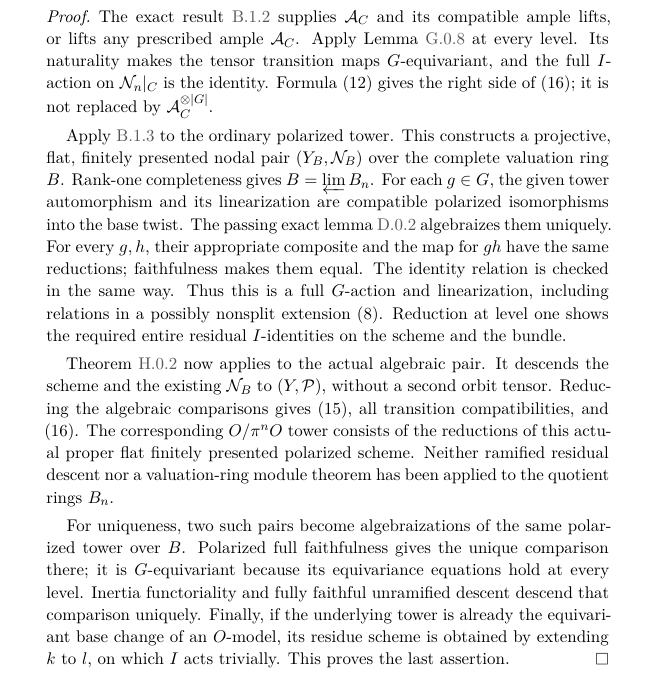
\begin{proof}
The exact result \hypertarget{foundations.nag003010.ample_lifts}{}\dep{cand:f5alg:towerpolarization} supplies
$\mathcal A_C$ and its compatible ample lifts, or lifts any
prescribed ample $\mathcal A_C$. Apply
\hypertarget{foundations.nag003010.full_group_orbit}{}Lemma~\ref{cand:f5mix:orbitkernel} at every level. Its naturality
makes the tensor transition maps $G$-equivariant, and the full
$I$-action on $\mathcal N_n|_C$ is the identity. Formula (12)
gives the right side of (16); it is not replaced by
$\mathcal A_C^{\otimes |G|}$.

Apply \hypertarget{foundations.nag003010.algebraization}{}\dep{cand:f5alg:algebraization} to the ordinary polarized
tower. This constructs a projective, flat, finitely presented
nodal pair $(Y_B,\mathcal N_B)$ over the complete valuation
ring $B$. Rank-one completeness gives $B=\varprojlim B_n$.
For each $g\in G$, the given tower automorphism and its
linearization are compatible polarized isomorphisms into the
base twist. The passing exact lemma
\hypertarget{foundations.nag003010.action_and_linearization}{}\dep{cand:f5eq:polarizedfullfaithfulness} algebraizes them
uniquely. For every $g,h$, their appropriate composite and
the map for $gh$ have the same reductions; faithfulness makes
them equal. The identity relation is checked in the same way.
Thus this is a full $G$-action and linearization, including
relations in a possibly nonsplit extension (8). Reduction at
level one shows the required entire residual $I$-identities
on the scheme and the bundle.

\hypertarget{foundations.nag003010.scheme_and_same_line_descent}{}Theorem~\ref{cand:f5mix:transitivity} now applies to the actual
algebraic pair. It descends the scheme and the existing
$\mathcal N_B$ to $(Y,\mathcal P)$, without a second orbit
tensor. Reducing the algebraic comparisons gives (15), all
transition compatibilities, and (16). The corresponding
$O/\pi^nO$ tower consists of the reductions of this actual
proper flat finitely presented polarized scheme. Neither
ramified residual descent nor a valuation-ring module theorem
has been applied to the quotient rings $B_n$.

For uniqueness, two such pairs become algebraizations of the
same polarized tower over $B$. \hypertarget{foundations.nag003010.polarized_uniqueness}{}Polarized full faithfulness gives
the unique comparison there; it is $G$-equivariant because
its equivariance equations hold at every level. \hypertarget{foundations.nag003010.comparison_descent}{}Inertia
functoriality and fully faithful unramified descent descend
that comparison uniquely. Finally, if the underlying tower
is already the equivariant base change of an $O$-model, its
residue scheme is obtained by extending $k$ to $l$, on which
$I$ acts trivially. This proves the last assertion.
\end{proof}
Typeset reader excerpt
Typed proof inputs
- NAG-002910 · selected whole (explicit current dependencies)
- NAG-002911 · selected whole (explicit current dependencies)
- NAG-002985 · selected whole (explicit current dependencies)
- NAG-003007 · selected whole (explicit current dependencies)
- NAG-003008 · selected whole (explicit current dependencies)
- NAG-003009 · selected whole (explicit current dependencies)
Reader cross-references
Proof map
Verified map inputs · NAG-003010
AND · joint registered proof inputs
- NAG-002910 · Polarization of a supplied curve tower · accepted whole
- NAG-002911 · Algebraization over the complete rank-one valuation ring · accepted whole
- NAG-002985 · Full faithfulness for polarized isomorphisms · accepted whole
- NAG-003007 · A finite-group orbit tensor with trivial inertia · accepted whole
- NAG-003008 · Result H.0.1 · accepted whole
- NAG-003009 · Result H.0.2 · accepted whole
NAG-003010 · Descent of a compatible mixed equivariant tower · Chapter argument