NAG-003148 · Accepted whole
The supplied equivariant tower interface
I Descent of the polarized mixed tower
Open in the English reader · PDF page 2075
Statement · exact TeX
\begin{corollary}[The supplied equivariant tower interface]
\label{cand:f5gen:towerdescent}
Keep the field hypotheses and notation of \hypertarget{foundations.nag003148.use.nag003147.field-and-model-notation}{}\hyperref[cand:f5gen:modeldescent]{Theorem~1.55.5}, and choose
\(0\ne\pi\in\mathfrak m_K\). Put \(B_n=B/\pi^nB\). Let \(X_n/B_n\) be a
supplied cartesian tower of proper, flat, finitely presented schemes,
with compatible semilinear \(G\)-actions. Suppose \(C=X_1\times_{B_1}l\)
is nodal of pure dimension one and \(I\) acts identically on the entire
scheme \(C\). Choose an ample \(\mathcal A_C\) and compatible ample lifts
\(\mathcal A_n\), and put \(\mathcal N_n=\bigotimes_{g\in G}\rho^*_{g,n}\mathcal A_n\).
Then there is a projective, flat, finitely presented nodal pair
\((Y,\mathcal P)\) over \(O\), with \(\mathcal P\) relatively ample,
and compatible equivariant polarized identifications
% @formula 23 232
\hypertarget{foundations.nag003148.formula.23}{}
\begin{equation}\tag{23}
 (Y,\mathcal P)\times_O B_n\simeq(X_n,\mathcal N_n).
\end{equation}
It is unique with these comparisons. The residue polarization, after
extension to \(l\), is
% @formula 24 232
\hypertarget{foundations.nag003148.formula.24}{}
\begin{equation}\tag{24}
 \left.\mathcal P\right|_{Y_k}\otimes_k l
   \simeq\bigotimes_{h\in G/I}(\bar\rho_h^*\mathcal A_C)^{\otimes|I|},
\end{equation}
with the quotient descent datum. An equivariant realization over \(O\)
necessarily has the stated entire-special-scheme inertia identity.
\end{corollary}
Full selected proof · exact TeX
\begin{proof}
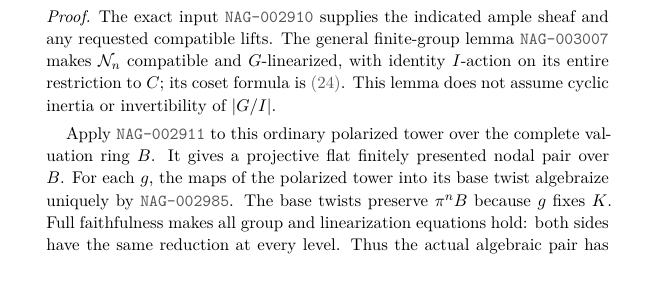
The exact input \hypertarget{foundations.nag003148.use.nag002910.prescribed-compatible-ample-lifts}{}\hyperref[cand:f5alg:towerpolarization]{\texttt{NAG-002910}} supplies the indicated
ample sheaf and any requested compatible lifts. The general finite-group
lemma \hypertarget{foundations.nag003148.use.nag003007.finite-orbit-full-residual-identity}{}\hyperref[cand:f5mix:orbitkernel]{\texttt{NAG-003007}} makes \(\mathcal N_n\) compatible and
\(G\)-linearized, with identity \(I\)-action on its entire restriction to
\(C\); its coset formula is \hyperlink{foundations.nag003148.formula.24}{(24)}. This lemma does not assume cyclic inertia
or invertibility of \(|G/I|\).

Apply \hypertarget{foundations.nag003148.use.nag002911.ordinary-polarized-algebraization}{}\hyperref[cand:f5alg:algebraization]{\texttt{NAG-002911}} to this ordinary polarized tower
over the complete valuation ring \(B\). It gives a projective flat finitely
presented nodal pair over \(B\). For each \(g\), the maps of the polarized
tower into its base twist algebraize uniquely by
\hypertarget{foundations.nag003148.use.nag002985.all-actual-base-twists}{}\hyperref[cand:f5eq:polarizedfullfaithfulness]{\texttt{NAG-002985}}. The base twists preserve
\(\pi^nB\) because \(g\) fixes \(K\). Full faithfulness makes all group
and linearization equations hold: both sides have the same reduction at every
level. Thus the actual algebraic pair has its full \(G\)-action and full
residual \(I\)-identities. \hypertarget{foundations.nag003148.use.nag003147.descend-actual-algebraized-pair}{}\hyperref[cand:f5gen:modeldescent]{Theorem~1.55.5} \hyperlink{foundations.nag003147.scheme-component}{descends that pair} and \hyperlink{foundations.nag003147.same-bundle-component}{that existing
polarization} without another orbit tensor, giving \hyperlink{foundations.nag003148.formula.23}{(23)} and \hyperlink{foundations.nag003148.formula.24}{(24)}.

Two such realizations become algebraizations of the same polarized tower
over \(B\). \hypertarget{foundations.nag003148.use.nag002985.polarized-equivalence-comparison}{}\hyperref[cand:f5eq:polarizedfullfaithfulness]{Polarized full faithfulness gives the unique comparison there}
and ensures its \(G\)-equivariance. The uniqueness and functoriality in
\hypertarget{foundations.nag003148.use.nag003147.descend-unique-equivariant-comparison}{}\hyperref[cand:f5gen:modeldescent]{Theorem~1.55.5} descend it. Necessity follows by reducing an equivariant
\(O\)-realization to \(l\), where inertia has trivial coefficient action.
The ramified affine theorem has been used only over valuation rings after
algebraization, never over the nonreduced rings \(B_n\).
\end{proof}
Typeset reader excerpt
Typed proof inputs
- NAG-001450 · selected whole (explicit current dependencies)
- NAG-002910 · selected whole (explicit current dependencies)
- NAG-002911 · selected whole (explicit current dependencies)
- NAG-002985 · selected whole (explicit current dependencies)
- NAG-003007 · selected whole (explicit current dependencies)
- NAG-003147 · selected whole (explicit current dependencies)
Proof map
Verified map inputs · NAG-003148
AND · joint registered proof inputs
- NAG-001450 · Finite-dimensional norms and finite field extensions · accepted whole
- NAG-002910 · Polarization of a supplied curve tower · accepted whole
- NAG-002911 · Algebraization over the complete rank-one valuation ring · accepted whole
- NAG-002985 · Full faithfulness for polarized isomorphisms · accepted whole
- NAG-003007 · A finite-group orbit tensor with trivial inertia · accepted whole
- NAG-003147 · The full tame inertia criterion for a supplied model · accepted whole
NAG-003148 · The supplied equivariant tower interface · Chapter argument