NAG-002329 · Accepted whole
The least contraction retaining specified vertices
Open in the English reader · PDF page 790
Statement · exact TeX
\begin{proposition}[The least contraction retaining specified vertices]
\label{v037:f5:leastcontraction}
Let $(\mathcal X,D)$ be a marked semistable algebraic model, with
vertex set $W$, and let $\varnothing\ne S\subset W$.
There is a marked semistable algebraic model $\mathcal X_S$ and
a morphism $\mathcal X\to\mathcal X_S$ retaining $S$ such that
every marked contraction $\mathcal X\to\mathcal Y$ retaining $S$
has a unique factorization
\[
                   \mathcal X\longrightarrow\mathcal Y
                                      \longrightarrow\mathcal X_S.
\]
Its geometric marked graph is the terminal graph of
Definition~\ref{v037:f5:protectedgraph}, with protected set equal
to the entire inverse image of $S$ and with $R$ the vertices whose
normalized residual component is $\mathbf P^1_{\overline k}$.
The construction uses finitely many actual contractions over $O$.
\end{proposition}
Full selected proof · exact TeX
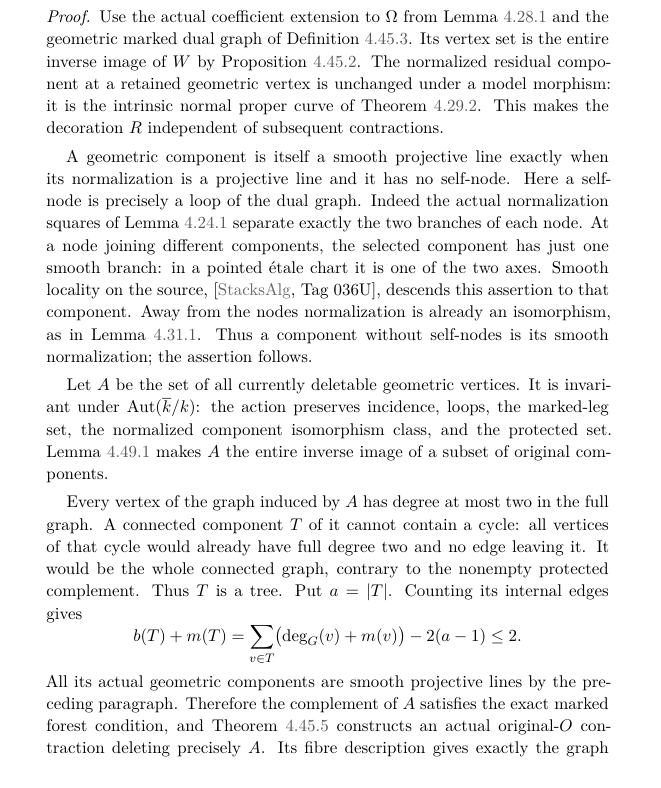
\begin{proof}
Use the actual coefficient extension to $\Omega$ from
Lemma~\ref{cand:algebraicmodelscalar} and the geometric marked dual graph of
Definition~\ref{v036:f5:modelclass}. Its vertex set is the entire
inverse image of $W$ by Proposition~\ref{v036:f5:vertexarithmetic}.
The normalized residual component at a retained geometric vertex
is unchanged under a model morphism: it is the intrinsic normal
proper curve of Theorem~\ref{cand:intrinsicresidualcurve}.
This makes the decoration $R$ independent of subsequent
contractions.

A geometric component is itself a smooth projective line exactly
when its normalization is a projective line and it has no
self-node. Here a self-node is precisely a loop of the dual graph.
Indeed the actual normalization squares of
Lemma~\ref{cand:normalizedmodelbranches} separate exactly the two
branches of each node. At a node joining different components,
the selected component has just one smooth branch: in a pointed
\textup{\'etale} chart it is one of the two axes. Smooth locality
on the source, \cite[Tag 036U]{StacksAlg}, descends this assertion
to that component. Away from the nodes normalization is already
an isomorphism, as in
Lemma~\ref{cand:smoothnodalnormalizationbasechange}.
Thus a component without self-nodes is its smooth normalization;
the assertion follows.

Let $A$ be the set of all currently deletable geometric vertices.
It is invariant under $\operatorname{Aut}(\overline k/k)$:
the action preserves incidence, loops, the marked-leg set, the
normalized component isomorphism class, and the protected set.
Lemma~\ref{v037:f5:geometriccomponentorbits} makes $A$ the entire
inverse image of a subset of original components.

Every vertex of the graph induced by $A$ has degree at most two
in the full graph. A connected component $T$ of it cannot contain
a cycle: all vertices of that cycle would already have full degree
two and no edge leaving it. It would be the whole connected graph,
contrary to the nonempty protected complement. Thus $T$ is a
tree. Put $a=|T|$. Counting its internal edges gives
\[
 b(T)+m(T)
   =\sum_{v\in T}\bigl(\deg_G(v)+m(v)\bigr)-2(a-1)
   \leq2.
\]
All its actual geometric components are smooth projective lines
by the preceding paragraph. Therefore the complement of $A$
satisfies the exact marked forest condition, and
Theorem~\ref{v036:f5:markedcontraction} constructs an actual
original-$O$ contraction deleting precisely $A$.
Its fibre description gives exactly the graph operations in
Lemma~\ref{v037:f5:pruningconfluence}, including the transfer of
a mark and the creation of a self-node from two coincident ends.
The whole marking remains the original finite \textup{\'etale}
$O$-scheme.

Repeat with all deletable vertices of the new model. Each nonempty
round removes original components and retains $S$, so after
finitely many rounds the process stops at a model $\mathcal X_S$
with no deletable geometric vertex. Each round is a forest
contraction and hence decomposes combinatorially into elementary
prunings by Lemma~\ref{v037:f5:pruningconfluence}.
That lemma identifies the resulting graph with its unique terminal
graph. Single geometric deletions in this combinatorial comparison
need not descend individually; every algebraic round used the
entire invariant forest and the original-field contraction theorem.

Now let $q:\mathcal X\to\mathcal Y$ be any marked contraction
retaining $S$. Proposition~\ref{v036:f5:forestnecessity} says that
its removed components satisfy the marked forest condition.
The target has the graph of that forest contraction: the exact
contraction of Theorem~\ref{v036:f5:markedcontraction} to the same
vertex set has the stated fibres and is identified with $q$ by
Proposition~\ref{v036:f5:contractionuniqueness}.
It is consequently a sequence of elementary prunings on the
geometric graph. Continuing to a terminal graph and applying
confluence shows that every retained vertex of $\mathcal X_S$
is a vertex of $\mathcal Y$. The entire-fibre identification
of Proposition~\ref{v036:f5:vertexarithmetic} gives the same
inclusion for original analytic vertices.
Theorem~\ref{v037:f5:algebraicdomination} now supplies the actual
map $\mathcal Y\to\mathcal X_S$, and
Corollary~\ref{v037:f5:intrinsicuniqueness} makes it marked.
Uniqueness of the morphisms inducing the generic identity proves
the factorization and its uniqueness.
\end{proof}
Typeset reader excerpt
Typed proof inputs
- NAG-002069 · selected whole (selected native whole)
- NAG-002094 · selected whole (selected native whole)
- NAG-002129 · selected whole (selected native whole)
- NAG-002131 · selected whole (selected native whole)
- NAG-002271 · selected whole (selected native whole)
- NAG-002274 · selected whole (selected native whole)
- NAG-002275 · selected whole (selected native whole)
- NAG-002276 · selected whole (selected native whole)
- NAG-002311 · selected whole (selected native whole)
- NAG-002312 · selected whole (selected native whole)
- NAG-002326 · selected whole (selected native whole)
- NAG-002328 · selected whole (selected native whole)
Reader cross-references
- cand:algebraicmodelscalar
- cand:intrinsicresidualcurve
- cand:normalizedmodelbranches
- cand:smoothnodalnormalizationbasechange
- v036:f5:contractionuniqueness
- v036:f5:forestnecessity
- v036:f5:markedcontraction
- v036:f5:modelclass
- v036:f5:vertexarithmetic
- v037:f5:algebraicdomination
- v037:f5:geometriccomponentorbits
- v037:f5:intrinsicuniqueness
- v037:f5:pruningconfluence
Proof map
Verified map inputs · NAG-002329
AND · joint registered proof inputs
- NAG-002069 · Normalization points and model branches · accepted whole Exact source window 174–197
- Use actual coefficient extension and intrinsic normalized residual curves. A component at an intercomponent split node has one smooth axis on the pointed etale chart, so the component is smooth there by smooth locality on the source. At a self-node the two branches give a loop. This preserves the rational normalization decoration under contraction.
- NAG-002094 · Scalar extension of algebraic formal models · accepted whole Exact source window 174–197
- Use actual coefficient extension and intrinsic normalized residual curves. A component at an intercomponent split node has one smooth axis on the pointed etale chart, so the component is smooth there by smooth locality on the source. At a self-node the two branches give a loop. This preserves the rational normalization decoration under contraction.
- NAG-002129 · The canonical residual curve at a component vertex · accepted whole Exact source window 174–197
- Use actual coefficient extension and intrinsic normalized residual curves. A component at an intercomponent split node has one smooth axis on the pointed etale chart, so the component is smooth there by smooth locality on the source. At a self-node the two branches give a loop. This preserves the rational normalization decoration under contraction.
- NAG-002131 · Smooth normalized residual components · accepted whole Exact source window 174–197
- Use actual coefficient extension and intrinsic normalized residual curves. A component at an intercomponent split node has one smooth axis on the pointed etale chart, so the component is smooth there by smooth locality on the source. At a self-node the two branches give a loop. This preserves the rational normalization decoration under contraction.
- NAG-002271 · The arithmetic of a model vertex · accepted whole Exact source windows 174–197, 239–256
- Use actual coefficient extension and intrinsic normalized residual curves. A component at an intercomponent split node has one smooth axis on the pointed etale chart, so the component is smooth there by smooth locality on the source. At a self-node the two branches give a loop. This preserves the rational normalization decoration under contraction.
- For any actual competing contraction retain the same complete protected preimage. Necessity and uniqueness identify its graph with the marked forest contraction. Confluence gives vertex inclusion, then actual domination and marked uniqueness give the unique original-field factorization.
- NAG-002274 · Exact marked contraction over the original field · accepted whole Exact source windows 239–256, 199–237
- For any actual competing contraction retain the same complete protected preimage. Necessity and uniqueness identify its graph with the marked forest contraction. Confluence gives vertex inclusion, then actual domination and marked uniqueness give the unique original-field factorization.
- The full set of deletable geometric vertices is invariant under residue automorphisms and is the entire geometric inverse image of original components. Each component of that subgraph is an acyclic degree-at-most-two tree disjoint from the nonempty protected set. The edge and leg count meets the marked forest hypothesis. Actual contractions use whole invariant rounds, with confluence only for the combinatorics.
- NAG-002275 · Necessity of the geometric marked forest condition · accepted whole Exact source window 239–256
- For any actual competing contraction retain the same complete protected preimage. Necessity and uniqueness identify its graph with the marked forest contraction. Confluence gives vertex inclusion, then actual domination and marked uniqueness give the unique original-field factorization.
- NAG-002276 · Algebraic uniqueness of an exact contraction · accepted whole Exact source window 239–256
- For any actual competing contraction retain the same complete protected preimage. Necessity and uniqueness identify its graph with the marked forest contraction. Confluence gives vertex inclusion, then actual domination and marked uniqueness give the unique original-field factorization.
- NAG-002311 · Algebraic domination from vertex inclusion · accepted whole Exact source window 239–256
- For any actual competing contraction retain the same complete protected preimage. Necessity and uniqueness identify its graph with the marked forest contraction. Confluence gives vertex inclusion, then actual domination and marked uniqueness give the unique original-field factorization.
- NAG-002312 · Algebraic uniqueness without a supplied common model · accepted whole Exact source window 239–256
- For any actual competing contraction retain the same complete protected preimage. Necessity and uniqueness identify its graph with the marked forest contraction. Confluence gives vertex inclusion, then actual domination and marked uniqueness give the unique original-field factorization.
- NAG-002326 · Geometric components over one original component · accepted whole Exact source window 199–237
- The full set of deletable geometric vertices is invariant under residue automorphisms and is the entire geometric inverse image of original components. Each component of that subgraph is an acyclic degree-at-most-two tree disjoint from the nonempty protected set. The edge and leg count meets the marked forest hypothesis. Actual contractions use whole invariant rounds, with confluence only for the combinatorics.
- NAG-002328 · Confluence and finite forests · accepted whole Exact source windows 239–256, 199–237
- For any actual competing contraction retain the same complete protected preimage. Necessity and uniqueness identify its graph with the marked forest contraction. Confluence gives vertex inclusion, then actual domination and marked uniqueness give the unique original-field factorization.
- The full set of deletable geometric vertices is invariant under residue automorphisms and is the entire geometric inverse image of original components. Each component of that subgraph is an acyclic degree-at-most-two tree disjoint from the nonempty protected set. The edge and leg count meets the marked forest hypothesis. Actual contractions use whole invariant rounds, with confluence only for the combinatorics.
NAG-002329 · The least contraction retaining specified vertices · Chapter argument